Showing posts with label vine. Show all posts

Sunday, July 19, 2015

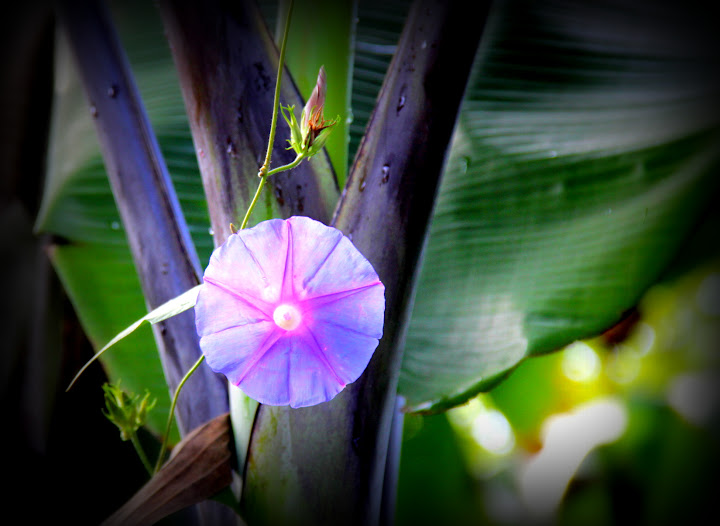
Today's Flowers: Morning Glory


Sunday, June 14, 2015

Today's Flowers: Trumpet Vine

非洲凌霄 Podranea ricasoliana, of Bignoniaceae family, an English common name pink trumpet vine known of its trumpet shaped flowers.

It is a vigorous, evergreen scrambler with glossy compound leaves. The beautiful trumpet shaped flowers are pale pink with carmine stripes and yellowish shading in the throat. Flowering time is summer and autumn. The fruit is a bean-like capsule containing winged seeds. Pink trumpet vine grows best in a sunny position, but will tolerate light shade. It needs a well drained soil and a strong support if it is to be grown as a climber. It has low water needs once established. It looks good grown over fences, very free flowering, virtually pest and disease free and drought resistant.

 
Some of other photos from my friend's, taken under the day light


Tuesday, January 27, 2015

Chayote 佛手瓜

Chayote, also known as choko or 佛手瓜, I did try to grow Chayote in container but there are no fruits bearing in a year time, it just growing plenty of leaves...I am not sure if it can grow well in Singapore climate. Has anyone grown the chayote before? 


Here’s what Chayote fruit looks like, my friend grow it in her back yard garden in LA. My friend told me that Chayote shoots also known as 龍鬚菜 in Chinese, Just simple stir fry with oil, chopped garlic and seasoning with salt,  Simply yummy!
Too bad I didn't know earlier...Chayote grows as a rambling vine, I was growing my Chayote in container last year, a big pot of chayote with a lot of young shoots growing every day, didn't know it is such a nice vegetable. 

I want to grow again this year for sure... 


Thursday, December 19, 2013

Liana Plants

Liana, long -stemmed woody vines rooted in the soil at ground level, use other trees as vertical support, to climb up to the canopy for sunlight in the  the forest.
Liana tangled itself, photographed in the Singapore botanical garden.

Wednesday, December 18, 2013

Climbers In Singapore Botanic Gardens


Thunbergia Laurifolia
Thunbergia laurifolia, Laurel clock vine or Blue trumpet vine, is native to India and the Indomalaya ecozone, the species occurs from Indochina to Malaysia. It is locally known as kar tuau in Malaysia and rang jeud in Thailand.

 Thunbergia Grandiflora
 
Thunbergia grandiflora is an evergreen vine in the family Acanthaceae. It is native to China, India, Nepal, Indochina and Burma and widely naturalised elsewhere.
 
 Phryganocydia corymbosa
[Trinidad Pink Trumper Vine]
...another climber plant in Singapore Botanic Gardens, I am not sure is it same kind to Thunbergia Laurifolia?

Sunday, September 29, 2013

Passion Fruits & Passion Flowers


Just some updated for my old post passion-fruits, it is bearing fruit now.
Passion-fruits are easy to grow in containers as long as with enough sunlight and fertilizer, of course, the container is required to a certain size, at least like a half wine barrel or our Chinese salt egg barrel. Ensure you use a good quality well-drained potting mix formulated specifically for containers.

One of very interesting notes about this plant, my friend planted one for almost 3 years with nicely grown leaves and beautiful flowers, but none of one fruit...Actually there are few type of similar plants, one as named Passiflora alatocaerulea forms no fruit.

Passiflora, known also as the passion flowers or passion vines, is a genus of about 500 species of flowering plants. The two pictures from above and below were taken from my potted plants, just for flowers, stunning beauty.

If you are growing only one passion fruit, select a self-pollinating cultivar, typically the purple fruit producing varieties.

The yellow variety of the passion fruit vine is best suited for our local tropical climate. It is a hardy plant with woody vines, a climber and will need trellising to hold it up. The pollination of this plant is usually facilitated with carpenter bees. You will need to manually pollinate your passion flowers if there is no bees available in your area. And normally need female and male flowers bloom at the same time to do so. These plants are self-sterile, which means that you will need to cross the pollen produced by one plant with the stamen of another plant. That is the reason, some old people say there are male plants and female plants. LOL. By the way according to my study, Yellow passion fruit vines will not accept the pollen of the purple variety. So choose the right type of plant if your space is limited.

Some other passion flora I found which is not in beautiful purple or blue, they are white flowers. Like the two pictures below:

                      This picture I found from Gardening with Wilson 


According Wilson say, This one, Passiflora foetida. a member of the Passion Fruit family, Passifloraceae. Unlike its relatives, the Giant Granadilla and the Common Passion Fruit (Passiflora edulis), Passiflora foetida occurs mainly as a weed. They were growing in wild in most tropical countries, including Singapore in the past, but now it is getting uncommon as Singapore continues to urbanise.  
The one below was seen in Beijing, on the roof top of people's house, cant tell its species. Pure white flowers with a circle of purple in the centre, very unique, indeed.   

My passion for passion flowers collection, hope you like my share. Wishing all of you have a wonderful weekend.


Saturday, August 3, 2013

Memory Of Morning Glory


Old photos from my archive, I planted them before, and soon they are all dead...I tried to plant morning glory many times, every one of them survived no longer than two months,  How to keep morning glory from dying?

Wednesday, September 19, 2012

J for Japanese Honeysuckle

The Japanese Honeysuckle (Lonicera japonica; Suikazura スイカズラ/吸い葛 in Japanese; Jinyinhua in Chinese; 忍冬 in Chinese and Japanese) is a species of honeysuckle native to eastern Asia including China (northern and eastern P.R.China and Taiwan), Japan, and Korea. It is a twining vine able to climb up to 10 metres (33 ft) high or more in trees, with opposite, simple oval leaves 3–8 centimetres (1.2–3.1 in) long and 2–3 centimetres (0.79–1.2 in) broad. The flowers are double-tongued, opening white and fading to yellow, and sweetly vanilla scented. The fruit is a globose[clarification needed] dark blue berry 5–8 millimetres (0.20–0.31 in) diameter containing numerous seeds.

Photos taken at the Healing Garden which is located next to the Singapore botanic Garden Visitor Centre, Nassim Gate. 
Info about this plants credited to the information sign in the garden and the online articles. I know nothing about this plant but will try to know more and have it one into my collection. :)
Sharing with

Tuesday, August 14, 2012

D For Dioscorea Sansibarensis


Dioscorea sansibarensis is a species of flowering plant in the yam family known by the common name Zanzibar yam. It is native to tropical Africa, and it is known elsewhere as an introduced species.
This yam grows from a tuber up to 40 centimeters wide. The vine may exceed 7 meters in length and can be 3 centimeters wide. It twines counterclockwise and can reach and grasp supporting trees before it produces its first leaf. The heart-shaped leaves are up to 46 centimeters long by 58 wide. The tip may taper into a tail-like extension. The bulbils are up to 6 centimeters wide and may be purplish in color. -From Wikipedia
This vine type of wild plants can be found at Off Upper Thomson Road, or out side of Singapore botanical garden etc. Although Bulbils of this species are poisonous, but I still like the heart shape leaves and the way they are growing.
Linking to ABC Wednesday

Wednesday, January 25, 2012

ABC Wednesday-B for blue pea

Clitoria ternatea is the botanical name. (Family : Fabaceae) I have written about this beautiful blue flowers before. The Blue Pea Flower, also popularly known as Bunga Telang (in Malay), also called Butterfly Pea, is a common ingredient used as natural food dye for making nonya kuehs. Read my previous post here: Nonya Cooking Ingredient - Bunga Telang

In today post, I will share with you some of my collection photos and more information of this edible plant.

Clitoria ternatea, such an imaginative name, but yet most of us only remember it as blue pea or butterfly pea. It is a perennial herbaceous plant. The pea-shaped flower is a bit hairy on the back. Though attractive, but I hardly see insects attracted to this flower, lacking of nectar I suppose.

Its leaves are elliptic and obtuse, with three leaflets growing from the slender stem. It grows as a vine or creeper, doing well in moist neutral soil. There are also white, pink, light purple and double petal variants of Butterfly Pea, but the the common one is the blue single-petaled flower variety.

This is the butterfly Pea that has double-petaled flowers in vivid deep blue color. They are about 4 cm long by 3 cm wide. This striking blue flowers demonstrated it's beauty on the roadside fence when I took the photo.

They are commonly and easily grown from seeds, they are so easy to bloom beautiful flowers everyday under full sun conditions and needs only a little attention.  It is commonly found on open fields and wastelands.

As I know the blue flowers variety is used to extract its dye to colour the Nonya Kuehs, the white variety is known to treat goitre.

The fruits are 5 – 7 cm long, flat pods with 6 to 10 seeds in each pod. They are edible when tender.

I am linking up this post with ABC Wednesday