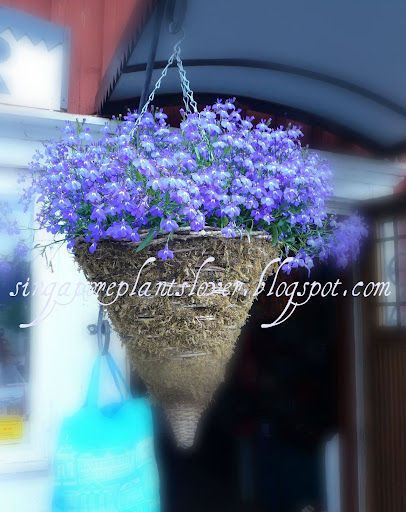
Lobelia chinensis, commonly known as the Chinese Lobelia, Herba Lobellae Chinensis, aze mushiro, and mizo kakushi, is a species of flowering plant in the family Campanulaceae. It is one of the 50 fundamental herbs used in traditional Chinese medicine, where it has the name (Chinese: 半边莲)
This is a small perennial herb that grows in tangled clumps from 15 centimetres (5.9 in) to 35 centimetres (14 in) long. It has a long, thin, branching stem that is olive green and green-brown crumpled narrow leaves. It has little to no odor and a sweet and pungent taste. When harvesting herbs for medical use, the ones with the greenest stems and yellower roots are preferred.
Showing posts with label herbs. Show all posts
Thursday, October 1, 2015
Herba Lobellae Chinensis: 半边莲
Thursday, April 2, 2015
My Edible Garden: Dill
Dill, Also known as dill weed, this is a green herb with wiry, thread-like leaves that grow in clusters. It has a strong, distinctive taste that is like a combination of fennel, anise and celery.
In some country it is one of the most popular herbs used in the kitchen, and, along with parsley, is used for various purposes. Fresh, finely cut dill leaves are used as topping to various soups...
In Chinese dill is colloquially called huixiang (茴香), or more properly shiluo (莳萝). It is used to cook fish.
In some country it is one of the most popular herbs used in the kitchen, and, along with parsley, is used for various purposes. Fresh, finely cut dill leaves are used as topping to various soups...
In Chinese dill is colloquially called huixiang (茴香), or more properly shiluo (莳萝). It is used to cook fish.
Wednesday, April 1, 2015
My Edible Garden: Ruta
• Ruta graveolens
• Rutaceae family
• Rutaceae family
• Commonly known as Rue
• Also known as herb of grace and herb of repentance
•Chinese Name 臭草, 别名臭艾、小香草
The leaves taste bitter, but The bitter leaf can be added to eggs, cheese, fish, or mixed with damson plums and wine to produce a meat sauce. In China, where it is known as chou-cao or "stinky grass" in Hong Kong, In some Chinese cantonese soup recipe, it is used to cook with green bean.
In Italy the leaves are used to flavour grappa della ruta, a form of brandy and also make their way into salad mixes as the Italians are fond of their bitter greens.
Recently I do some research on this herbal plant and find something interesting beside its commonly known as cooking green bean use.
From my research know that the flowers on the rue herb are yellow with petals that are frilly on the edges and the center of the flower is normally green. The flowers attracts some types of butterflies...
Most of us in Singapore grow Rue in a container, I never seen its flowers locally here. However rue normally grows to a height of 2 to 3 feet tall, a nice strongly scented evergreen subshrubs in the garden. It grows well with full sunlight in well drained soil. In its native range on the Balkan peninsula and southeast Europe, it grows in dry conditions in shallow, rocky soil. So do not overwater the plant especially the potted rue. Some said that rue should not be planted near basil, sage, or cabbage. (Not sure why)
Rue can be harvested and used in the house as an insect repellent. Simply cut some of the leaves and dry them, then put the dried leaves in cloth bags. These sachets can be placed where ever you need to repel bugs.
Some online article talk about its Medicinal uses: Extracts from rue have been used to treat eyestrain, sore eyes, and as insect repellent.
In folk medicine, rue has been used as an antispasmodic, sedative, and as a treatment for menstrual problems, to treat menstrual disorders, circulatory disorders, inflamed mucosa, toothache. In some cultures, rue extracts have been used as abortifacients. Documented adverse effects, including emmenagogue and abortifacient effects.
Rue has been used historically as tea to induce miscarriage by thousands of women all over the world from the Mediterranean, and Europe to Latin America and North America. Rue is a traditional abortifacient used by the Hispanic people in New Mexico.
Newly discover for the last point. :) Updated on 12 May 2105
• Also known as herb of grace and herb of repentance
•Chinese Name 臭草, 别名臭艾、小香草
The leaves taste bitter, but The bitter leaf can be added to eggs, cheese, fish, or mixed with damson plums and wine to produce a meat sauce. In China, where it is known as chou-cao or "stinky grass" in Hong Kong, In some Chinese cantonese soup recipe, it is used to cook with green bean.
In Italy the leaves are used to flavour grappa della ruta, a form of brandy and also make their way into salad mixes as the Italians are fond of their bitter greens.
Recently I do some research on this herbal plant and find something interesting beside its commonly known as cooking green bean use.
From my research know that the flowers on the rue herb are yellow with petals that are frilly on the edges and the center of the flower is normally green. The flowers attracts some types of butterflies...
Most of us in Singapore grow Rue in a container, I never seen its flowers locally here. However rue normally grows to a height of 2 to 3 feet tall, a nice strongly scented evergreen subshrubs in the garden. It grows well with full sunlight in well drained soil. In its native range on the Balkan peninsula and southeast Europe, it grows in dry conditions in shallow, rocky soil. So do not overwater the plant especially the potted rue. Some said that rue should not be planted near basil, sage, or cabbage. (Not sure why)
Love the blue green leaves
Some online article talk about its Medicinal uses: Extracts from rue have been used to treat eyestrain, sore eyes, and as insect repellent.
In folk medicine, rue has been used as an antispasmodic, sedative, and as a treatment for menstrual problems, to treat menstrual disorders, circulatory disorders, inflamed mucosa, toothache. In some cultures, rue extracts have been used as abortifacients. Documented adverse effects, including emmenagogue and abortifacient effects.
Rue has been used historically as tea to induce miscarriage by thousands of women all over the world from the Mediterranean, and Europe to Latin America and North America. Rue is a traditional abortifacient used by the Hispanic people in New Mexico.
Newly discover for the last point. :) Updated on 12 May 2105
Sunday, January 4, 2015
Java Tea Cat's Whisker
A fun and exotic-looking plant with its unique flowers in a pagoda like shaped with 5-6 cm long stamens that resembles a cat’s whiskers, hence the name 'cat's whisker' in english, mao xu cao (猫须草) in Chinese. The color of the flowers varies from white to purplish.
Cat's Whisker is an herbal plant that popular grows in Malaysia and Indonesia, It is botanically known as Orthosiphon aristatus and it belongs to the mint family. Other common names of this herb include the following – kidney plant, Indian kidney tea, Java tea, pokok Misai Kucing.
The leaves made into tea, are used for the treatment of High Blood Pressure, Diabetes and Kidney Disorders, it is believed that the leaves can effectively eliminate kidney stones the herb is used to treat acute and chronic kidney infections, bladder infections, urinary tract infections, frequent urination and bladder stones.
Cat's whiskers thrive in evenly moist soil and can adapt to full sun or partial shade. It is easy to propagate from a cutting stem, No serious problems with pests or diseases, one of the kinds of easy growing plants.
Cat's Whisker is an herbal plant that popular grows in Malaysia and Indonesia, It is botanically known as Orthosiphon aristatus and it belongs to the mint family. Other common names of this herb include the following – kidney plant, Indian kidney tea, Java tea, pokok Misai Kucing.The leaves made into tea, are used for the treatment of High Blood Pressure, Diabetes and Kidney Disorders, it is believed that the leaves can effectively eliminate kidney stones the herb is used to treat acute and chronic kidney infections, bladder infections, urinary tract infections, frequent urination and bladder stones.
Cat's whiskers thrive in evenly moist soil and can adapt to full sun or partial shade. It is easy to propagate from a cutting stem, No serious problems with pests or diseases, one of the kinds of easy growing plants.
Sunday, November 30, 2014
Friday, November 14, 2014
Medicinal Herb
Images from Love The Wild
This looks very interesting, right? I am looking for this plant in Singapore, since it grows in India.
Wednesday, November 12, 2014
Mulberry
I had one big Mulberry tree growing in a big pot in my childhood time, I kept silkworms, and use mulberry leaves to feed them...There are fun memory of Mulberry tree. The most exciting time is Autumn, all kids were waiting for the Mulberry fruits to ripen...Immature fruits are white, green, or pale yellow. In most species, the fruits turn pink and then red while ripening, then dark purple or black, and have a sweet flavor when fully ripe.
Sunday, November 2, 2014
Basil
Basil Plant --This is the most common herbal plant in Singapore.
Basil, Thai basil, or sweet basil, is a common name for the culinary herb Ocimum basilicum (UK /ˈbæzəl/;[1] US /ˈbeɪzəl/[2]) of the family Lamiaceae (mints), sometimes known as Saint Joseph's Wort in some English-speaking countries.Basil is native to India, China, Southeast Asia, and New Guinea.[3] It was originally domesticated in India, having been cultivated there for more than 5,000 years,[4] but was thoroughly familiar to Theophrastus[5] and Dioscorides. It is a half-hardy annual plant, best known as a culinary herb prominently featured in Italian cuisine, and also plays a major role in Southeast Asian cuisines of Indonesia, Thailand, Vietnam, Cambodia, Laos, and the cuisine of Taiwan. Depending on the species and cultivar, the leaves may taste somewhat like anise, with a strong, pungent, often sweet smell.There are many varieties of Ocimum basilicum, as well as several related species or species hybrids also called basil. The type used in Italian food is typically called sweet basil, as opposed to Thai basil (O. basilicum var. thyrsiflora), lemon basil (O. X citriodorum) and holy basil (Ocimum tenuiflorum), which are used in Asia. While most common varieties of basil are treated as annuals, some are perennial in warm, tropical climates, including holy basil and a cultivar known as 'African Blue'.
-from wiki
Saturday, August 31, 2013
Potted Roselle Pant
Finally, I have my own potted Roselle plant.
Roselle flower look like sea hibiscus
I like Roselle, I called them Ribena Plant before knowing the name, Actually it is, till today, conveniently referred to as Ribena. However, Roselle and the store bought Ribena syrup are two different things although similar in taste. Roselle is in actual fact, a wild hibiscus cultivar.
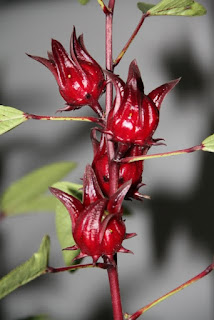
Roselle, I love this name, it is feminine, and the beautiful pinkish flower is definitely feminine too. The flowers have a blood red centre, opening light yellow in the morning and turning a gorgeous pink as they wither off by mid-day, and then close up and drop off later in the day. Fruits start to grow bigger and bigger.
I have seen a Roselle plant grow to a height of more than 7 feet tall and send branches out to 3-4 feet wide. There are limited growing in a container, so try to get a bigger container for Roselle, as it can get rather bushy, do not prune it, fruits will grow all along the stem right to the tip of each branch.
Each fruit is made up of conjoined calyces with pointed tips which enclose inside it, a pod that contains many black seeds when mature.
Harvest time...
I plug out the calyces from the fruit capsules and soak them into water for about half an hour before making Roselle juice, which is rich in vitamin C.
Wash, drain and cut calyxes (mine is about 20 pieces) into smaller pieces and put them into boiling water (about 2.5 litres). Add some sugar. Done!
The taste is just like Ribena drink.
Unused fresh calyxes can be sun dried and stored in an airtight container for next time use.
Thank you for visiting my blog. I would like to hear from you, follow me if you like gardening too. Cheers.
Wednesday, November 7, 2012
Thursday, September 20, 2012
Artemisia Vulgaris
Uncommon, on roadsides and waste ground.
Flowerheads c 2-3 mm diameter. Stems c 60-120 cm. Leaves c 5-8 cm long.
Flower-spikes appear late in season, see bottom pics. First 3 pics are pre-flowering.
ID: Leaves dark green above, whitish beneath, deeply divided into jagged segments. Florets brownish-red. Flowerheads densely clustered in long narrow leafy panicle.
Other features: Outer florets female, narrow. Inner florets hermaphrodite, widened at top. All florets are tubular.
According to wiki:
In Traditional Chinese medicine there is a belief that moxibustion of mugwort is effective at increasing the cephalic positioning of fetuses who were in a breech position before the intervention. A Cochrane review in 2012 found that moxibustion may be beneficial in reducing the need for ECV, but stressed a need for well-designed randomised controlled trials to evaluate this usage. Since it also causes uterine contractions, it has been used to cause abortion. A study of 260 Chinese women at 33 weeks of pregnancy demonstrated cephalic version within two weeks in 75% of fetuses carried by patients who were treated with moxibustion, as opposed to 48% in the control group.It has also been shown that acupuncture plus moxibustion slows fetal heart rates while increasing fetal movement. Two recent studies of Italian patients produced conflicting results. In the first, involving 226 patients, there was cephalic presentation at delivery in 54% of women treated between 33 and 35 weeks with acupuncture and moxibustion, vs. 37% in the control group. The second was terminated prematurely because of poor compliance with treatment, but found no difference between moxibustion and control groups.
For my own experience, the leaves and buds, best picked shortly before the plant flowers, it can be a cold dish or can be stir-fried with eggs or meat. I was told when I was a teenager, many women will enjoy more comfortable periods while having this herb. It is better to boil with red raspberry leaf for a drink during menstruation, though it tastes so so. But now it is difficult to get this plant in such a modern city in Singapore.
Thank you for visiting my blog. Sharing this post with Nature Note On Thursday.
Wednesday, September 19, 2012
J for Japanese Honeysuckle
The Japanese Honeysuckle (Lonicera japonica; Suikazura スイカズラ/吸い葛 in Japanese; Jinyinhua in Chinese; 忍冬 in Chinese and Japanese) is a species of honeysuckle native to eastern Asia including China (northern and eastern P.R.China and Taiwan), Japan, and Korea. It is a twining vine able to climb up to 10 metres (33 ft) high or more in trees, with opposite, simple oval leaves 3–8 centimetres (1.2–3.1 in) long and 2–3 centimetres (0.79–1.2 in) broad. The flowers are double-tongued, opening white and fading to yellow, and sweetly vanilla scented. The fruit is a globose[clarification needed] dark blue berry 5–8 millimetres (0.20–0.31 in) diameter containing numerous seeds.
Photos taken at the Healing Garden which is located next to the Singapore botanic Garden Visitor Centre, Nassim Gate.
Info about this plants credited to the information sign in the garden and the online articles. I know nothing about this plant but will try to know more and have it one into my collection. :)
Sharing with
Wednesday, September 12, 2012
Cat’s Whiskers
It is known as “Misai Kucing” or "Kumis Kucing" in the Malay language (translated as “Cat Whiskers”) because the sprays of white flowers look like a cat’s whiskers!
The scientific name for this plant is “Orthosiphon Aristatus” , this is a common ornamental plant or garden herb in Malaysia.
It is now getting more popular in Singapore too. They can be found in our neighbourhood garden. They are excellent for the home landscape as bees, butterflies and hummingbirds are attracted to the plant for its nectar.
The plants have tropical and exotic blossoms , color in white or bluish-purple, it has a long curved stamens that extend an inch or two past the petals, giving the long bloom spikes an attractive, whisker-like appearance. Nothing better than "cat's whiskers" for the enchanting description of its showy blooms.
...and this is the bud form of its flowers.
This shrub-type plant can reach about 2 feet in height and spreads 3 to 4 feet. Cat's whiskers grows well in evenly moist soil, full sun is recommended, but the plant will grow with several hours of filtered light combined with spotty direct sun. Frequent watering are needed especially in hot climates. Snipping off the flower spikes as they fade encourages new blooms to develop. It's easy to propagate cat's whiskers from cuttings, no serious problems with pests or diseases.
Cat's whiskers is herbal medicinal plants too, the leaves are made to drink, also known as Java Tea. Java Tea, which is used to help pass kidney stones. They are more other benefits of this plant what you can easily find online. Do share with me if you know something about this plants which I have not mentioned in this post.
Thank you for visiting my blog.
Sharing with: White
Wednesday
Tuesday, January 10, 2012
Ribena Plant-Roselle
Roselle Plants
Roselle, tt is an annual or perennial herb or woody-based subshrub, growing to 2–2.5 m (7–8 ft) tall. The leaves are deeply three- to five-lobed, 8–15 cm long, arranged alternately on the stems.
The flowers are 8–10 cm in diameter, white to pale yellow with a dark red spot at the base of each petal, and have a stout fleshy calyx at the base, 1–2 cm wide, enlarging to 3–3.5 cm , fleshy and bright red as the fruit matures. It takes about six months to mature.
Thursday, December 1, 2011
Abroma augusta
Botanical Name : Abroma augusta
English Name : Devill's cotton, Indian hemp
I found this tree in Singapore Botanical Garden, I have not seen it in other places. The tree is about 2 meters height. The leaves are repand, narrow and entire, have an oblong shap. Both leaves and stems are covered with soft, bristly hairs that are extremely irritating to the touch. The flowers are about 5 cm in diameter in dark maroon color, the flowers have 5 petals, are formed in terminal panicles. The seeds are contained in a cotton-like envelope.
According the given information, this unusual plant is one kind of herbal plant. In Ayurveda the juice of fresh leaves is very useful in female diseases of uterus and menstruation. It regulates the menstrual flow and acts as an uterine tonic.
English Name : Devill's cotton, Indian hemp
I found this tree in Singapore Botanical Garden, I have not seen it in other places. The tree is about 2 meters height. The leaves are repand, narrow and entire, have an oblong shap. Both leaves and stems are covered with soft, bristly hairs that are extremely irritating to the touch. The flowers are about 5 cm in diameter in dark maroon color, the flowers have 5 petals, are formed in terminal panicles. The seeds are contained in a cotton-like envelope.
According the given information, this unusual plant is one kind of herbal plant. In Ayurveda the juice of fresh leaves is very useful in female diseases of uterus and menstruation. It regulates the menstrual flow and acts as an uterine tonic.
Tuesday, October 18, 2011
ABC Wednesday-N for noni fruit
This is one of the common plants in Singapore, often seen especially in areas where kampongs (villages) used to be, and in the garden of many people's house. The tree have shiny leaves and will flower throughout the year, the flowers are tiny in white, it will
produce a multiple fruit that appears as an individual (like a pineapple). The fruit itself is ovoid and turns from green to a translucent white when fully ripe, with kind of odd smell. I was told the fruit can be cooked with curry, the seeds are edible when roasted. As written in a lot of article, the fruit contains many different nutrients and phytochemicals, were claimed that noni is the most important of the herbs used in medicine, however I am not the expert and only know the name of "noni juice." But I am curious why
Old Chinese people call this tree as "Dumb tree" in Hokkien, I am not sure where the name came from, any story behind it?
Linking to ABC Wednesday
Subscribe to:
Posts (Atom)