Showing posts with label topical. Show all posts

Saturday, December 24, 2011

Simpoh Air

If you ever stayed in Singapore before, you would surely be familiar with them. This is Simpoh Air,
Scientific name: Dillenia suffruticosa [Family: Dilleniaceae]. This distinctive shrubby tree grows vigorously on eroded soil, wasteland, forest edges and swampy areas. They are one of the common tropical flowering plants in Singapore. They are large shrubby tree can grow up to 6m tall, the large glossy green leaves, cheery big yellow flowers and pink star-shaped "fruits" make them very unique from others.
In old Singapore village time, the large leaves of the Simpoh Air were used to wrap food such as tempeh (fermented soyabean cakes), or formed into shallow cones to contain traditional "fast food" such as rojak.
The flowers are 8-10cm in width with five large thin petals, several flowers on a long stalk. They open at 3 am and last only a day. The petals drop off by 4pm and the sepals fold back on the young fruit in the evening. They are pollinated by bees which collect its pollen or by small beetles and flies that scramble over it. 
(The photo above shows the empty husk).
Almost every flower sets fruit. The flower stalk rotates slowly from pointing down when the flower blooms to pointing up when it starts to fruit. The unopened fruits are surrounded by thick red sepals. To distinguish them from flower buds, the fruits face upwards while flower buds face down. (You can see both of the flower buds and young fruit in the photo on the left.)

The fruits take exactly five weeks to set and opens at 3am, it splits open into pinkish star-shaped segments that contain 7-8 seeds enveloped by a fleshy red-coloured arils. The thin layer of red flesh surrounding the seeds is very attractive to birds which help to disperse the seeds across the landscape. The empty husk falls off at about 8am the following day.

These two Singapore stamps, the Simpoh Air (Dillenia suffruticosa) and the  Rhododendron (Melastoma malabathricum) with the value of 1st Local (26¢) and 2nd Local(32¢) respectively are part of the 2007 Flora & Fauna Definitive stamp series.
Linking up to Flowers On Satureday, Macro Flowers Saturday and Pink Saturday.
Merry Christmas!

Sunday, August 1, 2010

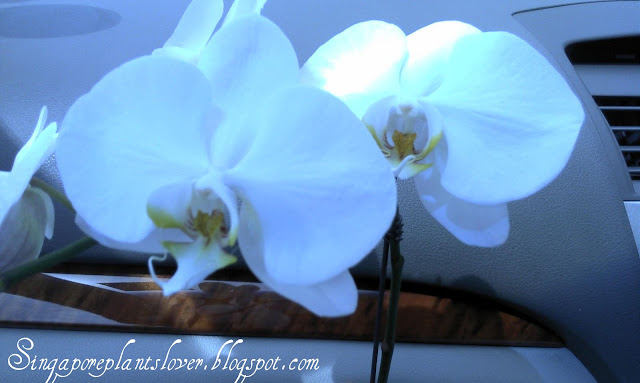
Today’s Flowers : Phalaenopsis Hybrid

Phalaenopsis Orchid

Phalaenopsis Orchid in black & white for This is not my favorite photographed orchid flowers, but it was taken with my cell phone. I am not a good photographer, it is difficult to take a good white flowers photo, hard to control the exposure. Photo was taken in the car, when the traffic light turned red... Phalaenopsis Orchid

More beautiful blooms on Todays' Flowers

Monday, July 19, 2010

Monday-Blue & Yellow

birds-of-paradise
Blue & yellow, two colors are matched so perfect in this topical flowers-bird of paradise.
More cool blue things are here, Mellow Yellow Monday is here.

Tuesday, October 13, 2009

Heliconia

I wish these pretty flowers brighten your week. Cheers. Visit Ruby Tuesday here.

Saturday, October 10, 2009

Tuesday, September 29, 2009

Firecracker Heliconia

Fire Crackers ( Heliconia rostrata)
Heliconia is a genus of about 100 to 200 species of flowering plants native to the tropical Americas and the Pacific Ocean islands west to Indonesia. Common names for the genus include lobster-claws, wild plantains or false bird-of-paradise. The last term refers to their close similarity to the bird-of-paradise flowers (Strelitzia). Collectively, these plants are also simply referred to as heliconias.
Heliconia rostrata is something that we, Singaporean are all too familiar with. It is one kind of very common road side flowers for our streetscape, as such, not many people want it to be planted in their gardens. But actually it can be planted in a big pot, with the flowers in red, yellow and a tinge of green facing downwards, this easy to take care kind of plant will sure light up any places. As long as there is enough sunlight and water, It would bloom from time to time and usually the blooms last for 3-4 weeks. The blooms look like firecrackers that we burn during Chinese New Year. The green leaves look more or less like banana leaves, it can be arranged by itself in a big glass vase for house decoration. 
Visit Ruby Tuesday here: