Wednesday, February 15, 2012
ABC Wednesday-E for eustoma
Wednesday, January 25, 2012
ABC Wednesday-B for blue pea
Clitoria ternatea is the botanical name. (Family : Fabaceae) I have written about this beautiful blue flowers before. The Blue Pea Flower, also popularly known as Bunga Telang (in Malay), also called Butterfly Pea, is a common ingredient used as natural food dye for making nonya kuehs. Read my previous post here: Nonya Cooking Ingredient - Bunga Telang
In today post, I will share with you some of my collection photos and more information of this edible plant.
Clitoria ternatea, such an imaginative name, but yet most of us only remember it as blue pea or butterfly pea. It is a perennial herbaceous plant. The pea-shaped flower is a bit hairy on the back. Though attractive, but I hardly see insects attracted to this flower, lacking of nectar I suppose.
Its leaves are elliptic and obtuse, with three leaflets growing from the slender stem. It grows as a vine or creeper, doing well in moist neutral soil. There are also white, pink, light purple and double petal variants of Butterfly Pea, but the the common one is the blue single-petaled flower variety.
This is the butterfly Pea that has double-petaled flowers in vivid deep blue color. They are about 4 cm long by 3 cm wide. This striking blue flowers demonstrated it's beauty on the roadside fence when I took the photo.
They are commonly and easily grown from seeds, they are so easy to bloom beautiful flowers everyday under full sun conditions and needs only a little attention. It is commonly found on open fields and wastelands.
As I know the blue flowers variety is used to extract its dye to colour the Nonya Kuehs, the white variety is known to treat goitre.
The fruits are 5 – 7 cm long, flat pods with 6 to 10 seeds in each pod. They are edible when tender.
I am linking up this post with ABC Wednesday
In today post, I will share with you some of my collection photos and more information of this edible plant.
This is the butterfly Pea that has double-petaled flowers in vivid deep blue color. They are about 4 cm long by 3 cm wide. This striking blue flowers demonstrated it's beauty on the roadside fence when I took the photo.
They are commonly and easily grown from seeds, they are so easy to bloom beautiful flowers everyday under full sun conditions and needs only a little attention. It is commonly found on open fields and wastelands.
As I know the blue flowers variety is used to extract its dye to colour the Nonya Kuehs, the white variety is known to treat goitre.
The fruits are 5 – 7 cm long, flat pods with 6 to 10 seeds in each pod. They are edible when tender.
I am linking up this post with ABC Wednesday
Wednesday, January 18, 2012
ABC Wednesday-A for African violet
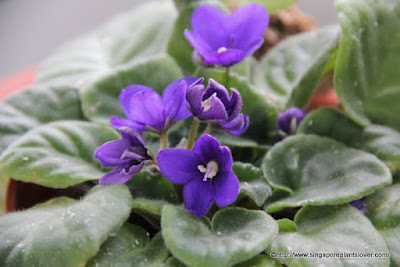
African Violet is one of the easygoing houseplant in Singapore. They don't need direct sunlight and just nice to survive in our weather. Grow them near the window where the place is bright and have sufficient air circulation with the indirect sunlight or indoor light. Here is my newly blooms of pink color flowers.
African Violet grow well in our temperature, especially during the month from Oct to Feb, when it is cooler at night while day time is not that hot. Below is another pot of blooms. I love this purple blue flowers. It is flowering once every two months.
Some of my growing tips would like to share here:
African Violet grow well in our temperature, especially during the month from Oct to Feb, when it is cooler at night while day time is not that hot. Below is another pot of blooms. I love this purple blue flowers. It is flowering once every two months.
Some of my growing tips would like to share here:
- Keep soil moist to dry, and allow soil around roots to dry out before watering again. Avoid getting water on the leaves as this can cause spotting damage. Don't over water it too, always maintain good air circulation around your plants. It can prevent the growth of fungi as Botrytis and Powdery Mildew. Keep them in door to avoid heavy rain especially in raining season.
- Always use a slightly shallow pot to prevent over watering. For the same reason, you should never allow an African Violet to remain in a pot that is too large for it. A lot of people like to change a bigger pot for the newly bought plant, they always think bigger space is good for the plants to grow, but it is not always right. If you use a pot too big or too deep, the African Violet's roots will not reach the bottom. As a result, the soil remains overly moist. African Violets perform best and are less susceptible to disease when their roots fit snugly into a pot.
- Most of the people like to spray water on the leaves, it is a very wrong way of watering this plant. Excessive moisture on the leaves can cause the plants infected by Powdery mildew (a light gray, powdery substance on the stems and petioles), promote the growth of fungi such as Crown Rot or Pythium etc. This shortens the life of blooms and even the growth of the plants.
- Just in case your plants get infected by diseases, one of my simple way is cutting off all the stems and leaves, allow two weeks time for new and healthy shoot to grow.
Tuesday, January 10, 2012
Ribena Plant-Roselle
Roselle Plants
Roselle, tt is an annual or perennial herb or woody-based subshrub, growing to 2–2.5 m (7–8 ft) tall. The leaves are deeply three- to five-lobed, 8–15 cm long, arranged alternately on the stems.
The flowers are 8–10 cm in diameter, white to pale yellow with a dark red spot at the base of each petal, and have a stout fleshy calyx at the base, 1–2 cm wide, enlarging to 3–3.5 cm , fleshy and bright red as the fruit matures. It takes about six months to mature.
ABC Wednesday-zephyranthes
Zephyranthes is a genus of 71 species in the Amaryllis family. There are numerous hybrids and cultivars. Common names for species in this genus include fairy lily, rainflower, zephyr lily, magic lily, Atamasco lily, and rain lily.
Linking to ABC Wednesday
Saturday, January 7, 2012
Coral vine
Antigonon leptopus, commonly called "Cadena de Amor" (Chain of Love) in Latin America and The Philippines and "Mexican Creeper", ''Coral Vine", "Honolulu Creeper " and "San Miguelito Vine" elsewhere, also have a name "Tears of the bride". It is a pink flowered vine in the buckwheat family, originally native to Mexico but is now found everywhere in the Tropics.
I often found this beautiful vines growing communally on a roadside fence, or outside of some private gardens. This vine was very common in the Singapore kampungs (villages) of yesteryear. This pretty and attractive climber is always attractive to bees when they are in full blooms with many pink flowers. I always wish I could had a garden fence to grow this dreamy sweet pink flowers. I tried to grow it on my corridor but it became a dead plant soon, as this Coral Vine needs a lot of full sun.
Until now, I still don't understand why it got the name "Tears of the bride", people often say they are the symbols of broken hearts, just because of the heart shaped leaves? Or because of that sweet pink colour has reminded the sweet memories of the bride?
I often found this beautiful vines growing communally on a roadside fence, or outside of some private gardens. This vine was very common in the Singapore kampungs (villages) of yesteryear. This pretty and attractive climber is always attractive to bees when they are in full blooms with many pink flowers. I always wish I could had a garden fence to grow this dreamy sweet pink flowers. I tried to grow it on my corridor but it became a dead plant soon, as this Coral Vine needs a lot of full sun.
Until now, I still don't understand why it got the name "Tears of the bride", people often say they are the symbols of broken hearts, just because of the heart shaped leaves? Or because of that sweet pink colour has reminded the sweet memories of the bride?
Tuesday, January 3, 2012
ABC Wednesday- yellow flowers
Not sure what is the name of this plants, bright cheerful flowers look like mini sunflowers or daisy, but the plant is growing like shrub, about 2 meter tall.
Linking to ABC Wednesday
Subscribe to:
Posts (Atom)